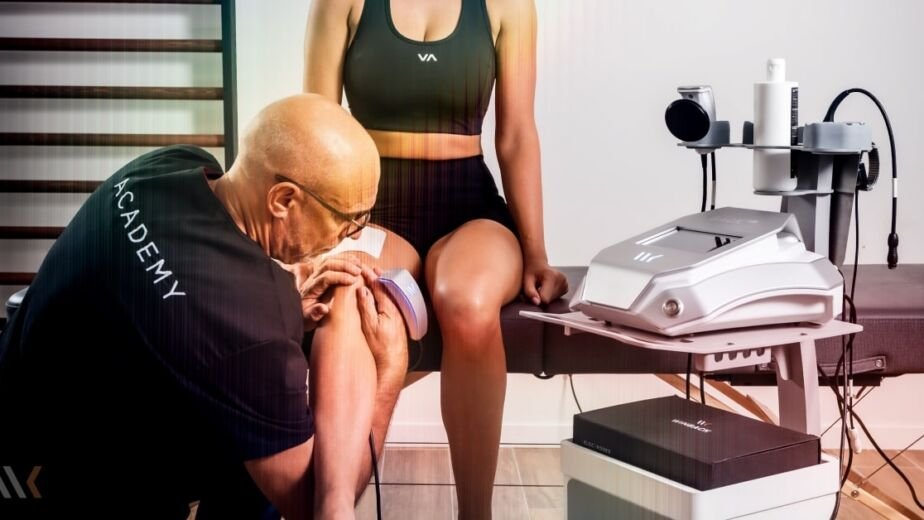
TECAR therapy has become one of the most talked-about technologies in modern rehabilitation. Yet, many clinicians still misunderstand how it works—or confuse it with outdated modalities. Let’s unpack the science behind TECAR and separate fact from fiction.
Myth #1: “TECAR is just deep heat.”
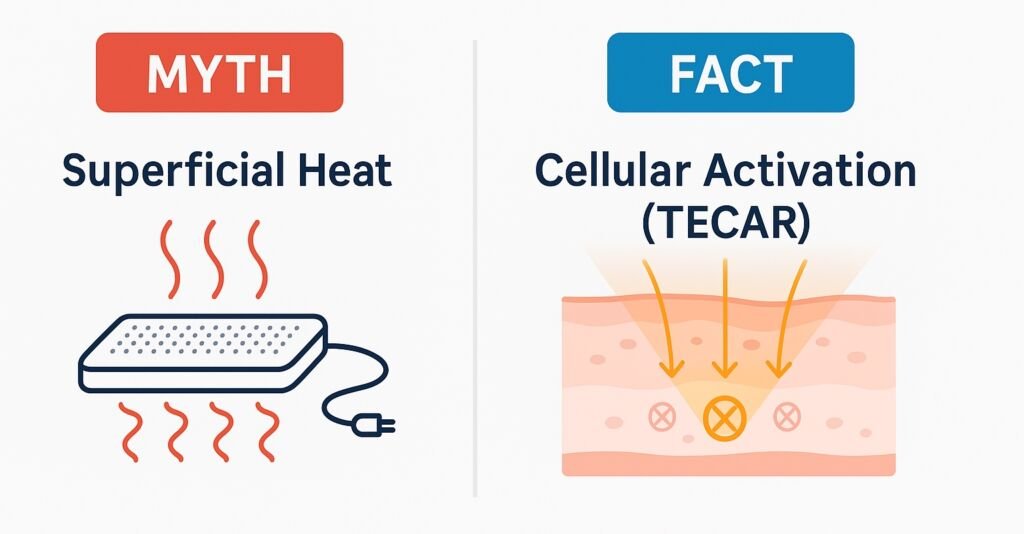
Fact: The warmth you feel during TECAR is simply a byproduct of cellular activity—not the goal.
TECAR (Transfer of Energy Capacitive and Resistive) works by delivering high-frequency radio waves that move ions within the body’s tissues. This ion exchange improves microcirculation, increases oxygen flow, and stimulates fibroblast and myocyte activity—creating an ideal environment for repair and regeneration. In other words, it’s not about heating tissue; it’s about energizing it.
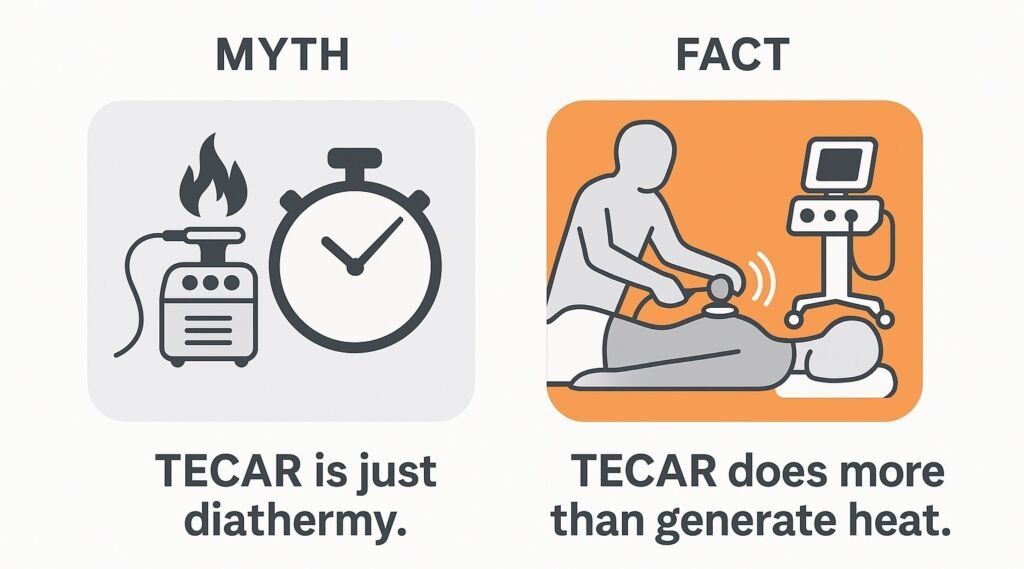
Myth #2: “It’s the same as diathermy.”
Fact: TECAR and diathermy may share the word “frequency,” but that’s where the similarity ends.
Traditional diathermy applies continuous electromagnetic energy to heat tissues uniformly, while TECAR offers targeted energy transfer through two precise modes:
- Capacitive mode (CET): Focuses on soft, superficial tissues like muscles and fascia.
- Resistive mode (RET): Reaches denser, deeper structures such as tendons, ligaments, and joints.
This dual-mode versatility allows clinicians to adapt treatments to tissue type and depth—something diathermy simply can’t match.
Myth #3: “It’s only useful for chronic conditions.”
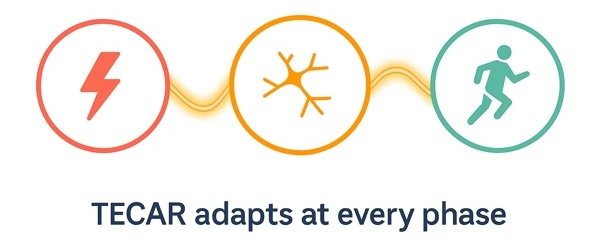
Fact: TECAR supports every phase of tissue healing—acute, subacute, and chronic.
- In the acute phase, it helps modulate inflammation and ease pain by restoring cellular balance.
- In the subacute stage, it accelerates repair and enhances fibroblast proliferation.
- And in chronic cases, it reactivates local metabolism and restores range of motion.
That means TECAR is as valuable for post-injury athletes as it is for long-term musculoskeletal issues.
Myth #4: “You need long treatment times.”
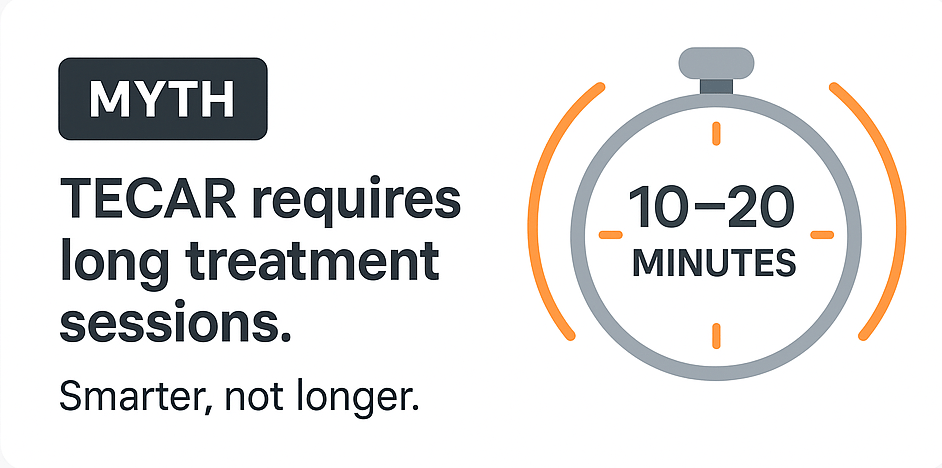
Fact: Protocols today are fast, efficient, and workflow-friendly.
Thanks to preset clinical programs and clear visual guidance, most TECAR treatments take 10–20 minutes—and can even run hands-free while the clinician works on another task or supervises exercise. Shorter sessions mean better patient throughput without compromising care quality.
Myth #5: “It’s complicated to learn.”

Fact: Modern TECAR platforms are designed for simplicity.
Systems like Winback guide clinicians step-by-step through visual protocols, making it easy to target specific pathologies or goals. Combine that with access to the Winback Academy, offering tutorials, case studies, and 1-on-1 clinical support—and integration becomes effortless.