
Winback TECAR therapy delivers high-frequency electromagnetic energy into the body, stimulating ionic movement and tissue oscillation. Though the treatment nodes are applied locally, the physiological response it provokes extends far beyond the immediate region.
Vascular Activation and Systemic Circulation
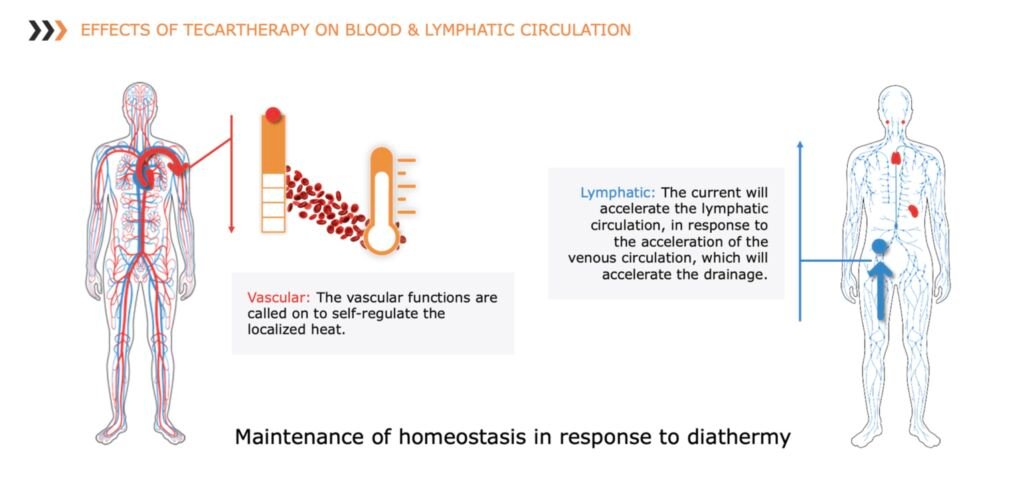
TECAR increases local tissue temperature and ionic exchange, which triggers vasodilation. As arterial flow increases in one region, the body’s autonomic regulatory mechanisms respond by redistributing blood flow system-wide to maintain homeostasis.
This ‘ripple effect’ means that while energy is delivered to one region (i.e. shoulder), cardiac output and peripheral vascular resistance adjust globally, increasing perfusion across the entire circulatory network.
Lymphatic System Mobilization
In parallel, TECAR enhances interstitial fluid dynamics. This promotes microcirculation and lymphatic drainage, stimulating smooth muscle contractions in lymphatic vessels. The lymphatic system is anatomically and functionally integrated with the venous system, a local activation can elevate lymphatic return throughout the body, improving detoxification. This same mechanism can mobilize latent biological agents such as viruses, bacteria, or neoplastic cells. As a professional precaution, oncologic or infectious conditions must be ruled out or cleared by a physician prior to treatment.
Autonomic Nervous System Mediation
TECAR also interfaces with the autonomic nervous system (ANS). The mild thermal and electrical stimuli shift the balance toward parasympathetic dominance, promoting relaxation, improved vascular compliance, and reduced sympathetic tone. This neurovascular modulation contributes to the global circulatory effect, as ANS-mediated vasomotor responses influence distant tissues beyond the treatment site.
Global Circulatory Facilitation
TECAR therapy can act as a whole-body circulatory modulator rather than a purely local treatment. Its benefits are substantial by enhanced healing, reduced inflammation, and improved recovery. Awareness of the systemic physiology ensures that treatment is applied with medical oversight, particularly for patients with complex conditions.