Clinicians often ask why some TECAR Therapy sessions generate strong, immediate superficial warmth, while others create a slower, deeper thermal effect. The answer is frequently misunderstood.
It’s not intensity that determines depth.
It’s frequency.
Thanks to controlled laboratory testing performed in collaboration with the CNRS, we now have some of the clearest evidence to show how 500 kHz (CET Soft) and 300 kHz (CET Deep) interact with tissue at different depths. These measurements offer clinicians a simple, reliable framework for choosing the right mode for each treatment goal.
How TECAR Therapy Frequency Determines Treatment Depth
TECAR Therapy uses high-frequency radio waves to create endogenous heating inside biological tissue. As frequency increases, energy attenuates more rapidly—meaning it dissipates sooner and concentrates in superficial layers. As frequency decreases, energy penetrates deeper before converting into heat.
The CNRS data confirms this fundamental principle:
- 500 kHz (CET Soft) → strongest heating in 0–3 cm
- 300 kHz (CET Deep) → progressively greater heating in 3–6 cm
These findings were validated using biomimetic tissue phantoms, ultrasound monitoring, and temperature-related strain imaging.
TECAR Therapy Temperature Graphs: What They Reveal
Two graphs from the study make the depth difference unmistakable.
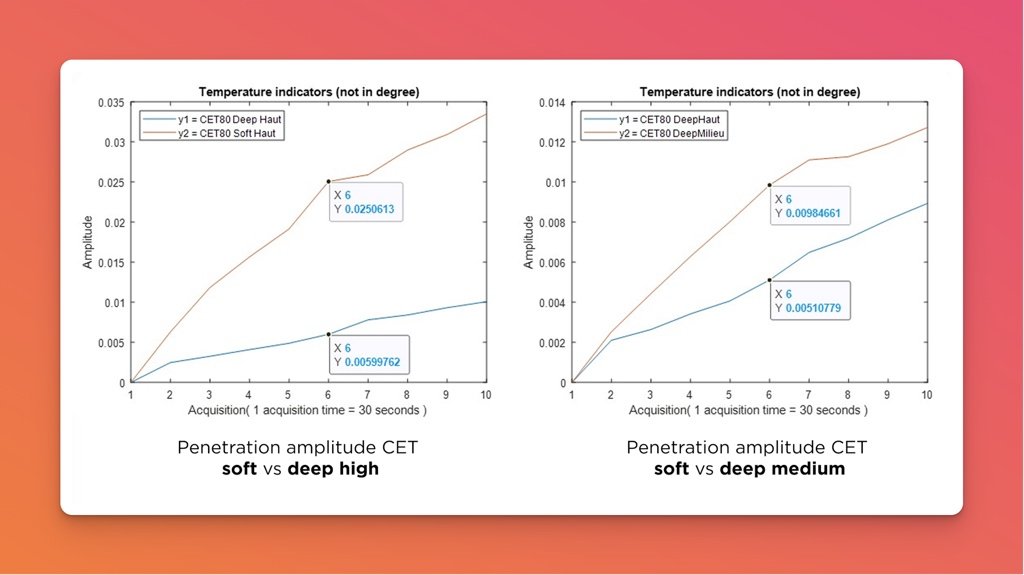
1. CET Soft vs CET Deep — High Probe Position (0–3 cm)
Graph Summary:
- CET Soft (500 kHz) shows a steeper, higher thermal rise in superficial tissue.
- CET Deep (300 kHz) produces a smaller amplitude curve in this layer.
This confirms that 500 kHz concentrates energy at the surface, ideal for tissue affecting the skin, fascia, and superficial musculature.
(White Paper pp. 12–14.)
2. CET Soft vs CET Deep — Mid Probe Position (3–6 cm)
Graph Summary:
- CET Deep (300 kHz) now surpasses CET Soft in amplitude.
- CET Soft’s thermal effect tapers off significantly with depth.
This demonstrates that 300 kHz preferentially deposits energy in deeper layers, even when intensity remains constant.
(White Paper pp. 12–14.)
Superficial vs Deep Heating: What It Means Clinically
500 kHz (CET Soft) → Superficial Action (0–3 cm)
Ideal for:
- Superficial fascial stiffness
- Protective muscle tension
- Trigger points
- Acute or sensitive tissue
- Local circulatory activation
Why it works:
The higher frequency dissipates quickly, delivering heat exactly where these structures live.
300 kHz (CET Deep) → Deep Action (3–6 cm)
Ideal for:
- Chronic muscular stiffness
- Deep fascial adhesions
- Reduced joint mobility
- Older or fibrotic soft tissue
- Pre-exercise preparation of major muscle groups
Why it works:
Lower frequency penetrates deeper before energy conversion occurs, making it ideal for dense or chronic tissues that require sustained deep thermal influence.
The Common Misconception: Intensity vs Frequency in TECAR Therapy
Clinicians frequently assume:
“If I increase intensity, I will reach deeper tissues.”
The CNRS data proves otherwise:
- Intensity controls how much heat is created.
- Frequency determines where the heat is deposited.
Thermal strain maps from the white paper illustrate this clearly:
At both 40% and 80% intensity, the shape of the depth profile does not change—only the amplitude changes.
(White Paper p. 13–14.)
This means:
- You cannot force deep heating using 500 kHz simply by turning up the power.
- You must select 300 kHz if the therapeutic goal is controlled deep heating.
Research Methods Behind TECAR Therapy Depth Testing
The Winback–CNRS study used:
- Tissue phantoms mimicking skin and muscle
- Ultrasound probes positioned at 0–3 cm and 3–6 cm
- Controlled 80% intensity
- Ghost imaging for temperature-related strain
- Sequential acquisitions every 30 seconds for thermal curves
This rigorous method allowed researchers to quantify and compare energy distribution across depths with high precision.
(White Paper pp. 12–16.)
How to Choose the Right TECAR Therapy Frequency
Use this simple clinical guide:
Choose 500 kHz (CET Soft) when the goal is:
- Surface relaxation
- Reducing acute tension
- Improving superficial glide
- Trigger point reduction
- Enhancing comfort before manual therapy
Choose 300 kHz (CET Deep) when the goal is:
- Treating chronic stiffness
- Releasing deep fascia
- Improving mobility in large muscle groups
- Preparing athletes for high-load movements
- Targeting deeper kinetic chains
Key Takeaway for Clinicians
The science is now clear:
Depth is not determined by intensity. Depth is determined by frequency.
By choosing the appropriate mode—CET Soft or CET Deep—clinicians can deliver precise, targeted therapeutic effects that match the tissue, condition, and clinical objective.
This frequency-specific approach is one of the reasons TECAR Therapy continues to evolve into a more measurable, predictable tool for rehabilitation, performance, and wellness.
See TECAR Therapy Depth Differences Live
See real-time temperature distribution and learn how to integrate frequency selection into daily practice.