
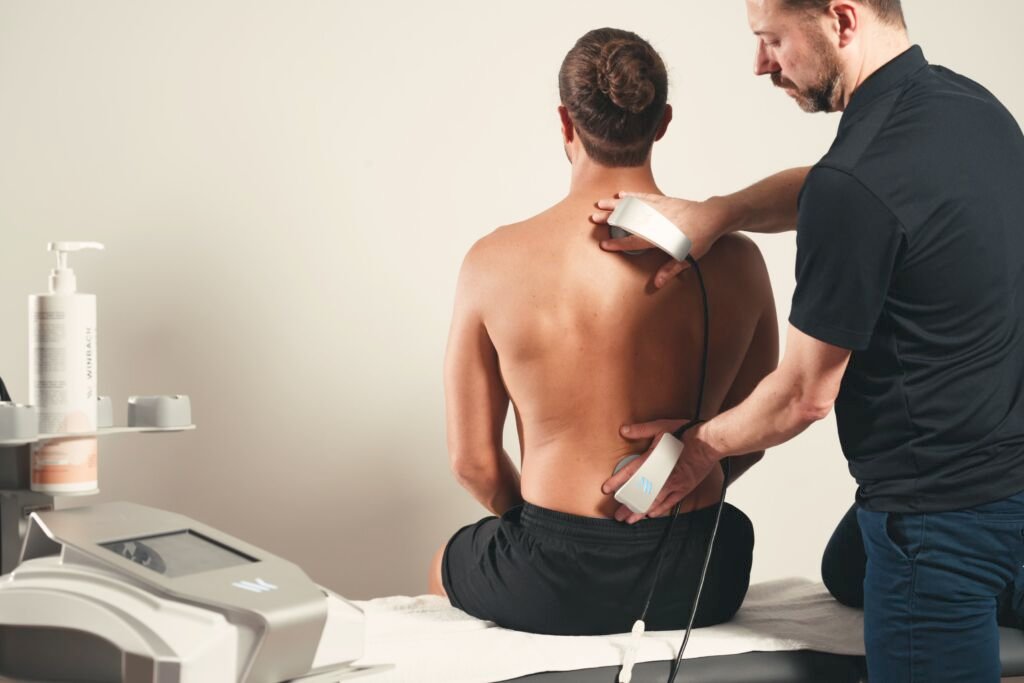
Provider Name & Treatment Location: Denis Donovan, PT, DPT, Cert. DN — Muscle Mechanic
Key Words: TECAR therapy; non-specific low back pain; lumbopelvic dysfunction; gluteal activation; posterior oblique sling; capacitive resistive electric transfer (CET and RET)
Summary (Abstract)
This case report describes the use of adjunctive TECAR (Capacitive and Resistive Electric Transfer) therapy combined with a progressive Fit+ → Performance+ loading protocol in an adult patient presenting with chronic non-specific low back pain (LBP) and bilateral lumbopelvic dysfunction. At baseline the patient demonstrated a quad-dominant compensatory movement strategy with measurable bilateral asymmetry on Kinvent dynamometry and depressed gluteus maximus activation on surface EMG during single-leg hip thrust testing. Following a structured course of TECAR layered with Hi-TENS, Hi-EMS, manual therapy and progressive posterior-chain loading, the patient demonstrated +20–35% gains in isometric hip strength, near-resolution of bilateral asymmetry, and a near-doubling of gluteus maximus EMG activation, with reciprocal down-regulation of rectus femoris recruitment. The glute-to-rectus femoris ratio flipped from RF-dominant to glute-dominant on both sides.
What is unique about this case is the use of objective neuromuscular outcome measures (Kinvent isometric force, surface EMG, coactivation index) alongside conventional pain and ROM measures to demonstrate that TECAR’s biological mechanisms — cellular metabolism, synaptic interference, and endogenous diathermy — can be quantified through restored motor recruitment, not only subjective pain relief. The primary take-away is that TECAR is most effective as an adjunct to progressive loading and motor-control retraining, and that active application during loaded movement (not passive treatment alone) drives the largest functional gains.
Key take-away lessons:
- Winback’s Fit+ Hands-Free program enables concurrent diathermy, neuromuscular stimulation, and analgesia in a single hands-free application — a capability unique to the Winback polyfrequency platform.
- Passive-to-active progression using Fit+ safely ramps load tolerance while continuously delivering all three modalities, maximising therapeutic effect at every stage of rehabilitation.
- Objective measurement with Kinvent dynamometry and EMG co-activation index is essential for demonstrating neuromuscular changes that subjective pain scores alone cannot capture.
- Restored glute-to-RF dominance — not just pain reduction — is the true marker of successful posterior chain rehabilitation.
Introduction
Non-specific LBP affects approximately 80% of adults during their lifetime and remains the #1 cause of disability worldwide, with a typical acute care window of 4–6 weeks. The traditional postural-structural-biomechanical (PSB) model has been progressively dismantled (Lederman, 2010) — lordosis, pelvic tilt, leg-length inequality and weak core have not been shown to reliably predict who develops LBP. Recovery is increasingly framed as a biological and neuromuscular process rather than a mechanical correction. Within that framework, TECAR therapy is positioned as a tissue-level intervention that boosts cellular metabolism, modulates pain at the nociceptor level via synaptic interference, and produces endogenous heat (diathermy) to support repair.
This case is unique in pairing that biological mechanism with a regional-interdependence rehabilitation model — proximal stability (lumbar/inner unit) before distal mobility (hip, T-spine) — and in using objective Kinvent and EMG data to track posterior-chain restoration session over session.
Winback Polyfrequency Technology
The Winback device is a polyfrequency platform that combines three distinct energy modalities in a single clinical application, delivered simultaneously through a hands-free electrode setup:
- TECAR (Transfer of Energy Capacitive and Resistive): High-frequency radiofrequency energy operating across 300–1000 kHz, delivered via CET (Capacitive) electrodes targeting superficial soft tissue and RET (Resistive) electrodes targeting deep structures including joints, tendons, and bone. CET and RET generate endogenous diathermic heat, stimulating cellular metabolism, improving local vascular perfusion, and modulating the inflammatory cascade.
- Hi-EMS (High-frequency Electrical Muscle Stimulation): Electrical stimulation in the 1.5–4 kHz range, enabling deep neuromuscular recruitment that reaches stabilizing muscles such as the multifidus and gluteal complex — structures that are difficult to fully recruit with conventional surface NMES or voluntary exercise alone.
- Hi-TENS (High-frequency Transcutaneous Electrical Nerve Stimulation): High-frequency RF energy pulsed at low frequencies to deliver targeted peripheral analgesia and central neuromodulation, reducing pain inhibition and enabling higher-quality neuromuscular recruitment during exercise.
The simultaneous delivery of these three frequency ranges through a single hands-free system is a defining feature of the Winback platform, and it is the foundation of the Hands-Free CARE+ programs. These programs can be applied passively (patient at rest, receiving diathermy, muscle activation, and analgesia simultaneously) or actively (patient performing therapeutic exercise while all three modalities run in parallel), supporting a progressive, targeted ramp-up of load tolerance across every phase of rehabilitation.
The Fit+ Care+ program specifically targets proximal stability — the core, gluteal complex, and lumbar spine — making it the logical clinical choice for LBP presentations driven by posterior chain inhibition and dysfunctional loading strategy. To the author’s knowledge, this case report is the first documented clinical observation of the Winback Fit+ polyfrequency combination applied to non-specific LBP with objective neuromuscular outcome measurement. It is presented as an initial clinical observation to inform and motivate future controlled investigation, rather than as definitive proof of efficacy.
Patient Information / Diagnosis
Demographics: 24 year old male; Firefighter EMT Trainee
Chief Complaint: Lumbar disc derangement with multi-level herniations (L4-L5 and L5-S1) with episodic flares; difficulty with rotational and loaded tasks (e.g., running, lifting, carrying objects >40 lbs, and pulling hose/swinging an axe — work-related duties).
Diagnosis: Non-specific chronic LBP with lumbopelvic dysfunction; bilateral gluteus maximus inhibition with rectus-femoris-dominant movement strategy. SIJ provocation cluster screened; no radicular symptoms; no red flags.
Relevant Medical / Family History: Family history of lumbar disc derangement.
Past Interventions and Outcomes: 6 weeks of conventional PT prior to TECAR intervention with minimal change in symptoms; still experiencing episodic flares with return to activity.
Clinical Findings
Subjective
- VAS at rest: 0/10 | VAS with rotational loading and single-leg tasks: 8/10.
- PSFS: functional deficits in work-related duties, lifting, carrying, running, and pulling a hose/swinging an axe.
- Patient-reported quality-of-movement notes: Pre-intervention, patient noted difficulty stabilizing his core to perform isometric contraction, with the right side feeling more weak/awkward compared to the left, despite right-side dominance.
Objective
Baseline objective findings:
- Kinvent isometric hip strength — Supine Hip Abduction: Left 9.4 kg / Right 8.6 kg (9.0% asymmetry); Hip Extension: Left 30.6 kg / Right 27.1 kg (11.4% asymmetry).
- Surface EMG during single-leg hip thrust — Gluteus Maximus peak: Left 35.2 µV / Right 20.2 µV; Rectus Femoris peak: Left 52.2 µV / Right 57.5 µV.
- Coactivation Index (RF antagonist co-contraction during glute-dominant task): Left 67.2 / Right 75.5 — indicating quad-dominant strategy.
- Glute-to-RF ratio: Left 0.67 / Right 0.35 — both sides RF-dominant (ratios below 1.0).
- Movement screen consistent with proximal instability and reduced hip internal rotation; no neurological deficit; negative SLR; no centralization deficit.
Detailed Treatment, Timeline, and Outcome
Information from this episode of care is organized below as a timeline followed by diagnostic assessment and intervention detail.
1. Timeline
| Phase | Week | Focus |
| Evaluation | Wk 0 | Subjective + objective baseline; Kinvent + EMG pre-test; VAS, PSFS, Kinotek ROM. |
| Acute / Pain Modulation | Wk 1–2 | CET at low–moderate intensity (10–50%); Hi-TENS Static 5 Hz for analgesia; passive Fit+ in static positions; education and load management. |
| Sub-Acute / Activation | Wk 3–4 | Transition CET → RET; moderate intensity (30–50%); Hi-EMS Focal to S1–L1 multifidi; introduction of active Fit+ Core program (banded chops, dead-bug, neutral-spine progressions). |
| Functional / Loading | Wk 5–7 | RET dominant at moderate–high intensity (50–70% / Boost 40%+); Performance+ for distal mobility; posterior oblique sling work (single-leg deadlift, diagonal chops, bird-dog with banded resistance); active TECAR during exercise. |
| Re-Assessment | Wk 8 | Repeat Kinvent + EMG; VAS, PSFS, Kinotek ROM; return-to-task screening. |
2. Diagnostic Assessment
Diagnostic methods: Subjective intake; lumbar AROM screening; SIJ provocation cluster (FABER, Gaenslen, Thigh Thrust, PSIS palpation, compression/distraction) — cluster of ≥3 positives = 85% sensitivity; neurological screen (DTRs, dermatomes, myotomes); Kinotek ROM for hip and lumbar/T-spine; Kinvent isometric dynamometry for hip abduction and extension; surface EMG (gluteus maximus and rectus femoris channels) during single-leg hip thrust; VAS pain; Patient-Specific Functional Scale (PSFS).
Diagnosis (and differential): Primary — non-specific chronic LBP with lumbopelvic dysfunction and posterior-chain inhibition. Differentials considered and screened: SIJ dysfunction, lumbar disc derangement/radiculopathy, hip joint mobility loss with referral, piriformis syndrome.
Prognostic characteristics: Favorable — absence of red flags, no neurological deficit, intact directional preference, motivated patient, baseline measurable asymmetry that is responsive to neuromuscular re-education.
Therapeutic Intervention
1. Type of Intervention
Combined TECAR therapy (Capacitive Electric Transfer — CET, and Resistive Electric Transfer — RET) layered with Hi-TENS and Hi-EMS modalities, delivered alongside manual therapy and a progressive Fit+ → Performance+ exercise program.
Care+ Program Used: Fit+ (proximal stability — core, glute, spine) progressing to Performance+ (distal mobility — hip, T-spine) once acute symptoms permitted active loading.
TECAR Settings: Carrier frequency 300 kHz throughout. Intensity scaled to phase — see table below. Total session length 15–20 minutes; 2–3 sessions per week.
| Phase | Mode | Intensity | Duration |
| Acute (Wk 1–2) | CET (CAP) | Med 10–20% or Low 30–50% | ~10 min, paraspinals + QL + TLF |
| Sub-Acute (Wk 3–4) | CET → RET | Med 30–50% | ~15 min; multifidus, posterior elements (indirect) |
| Functional (Wk 5+) | RET dominant | Med 60%+ or Boost 40%+ | 15–20 min; periosteal and deep multifidi during loaded exercise |
| Adjuncts (all phases as indicated) | Hi-TENS / Hi-EMS | Hi-TENS Static 5 Hz for analgesia; Hi-EMS Focal for deep multifidi (S1–L1) | Layered with TECAR; PainFree for sub-acute/chronic, PushBack for acute |
2. Protocol Steps
- Patient positioned prone or side-lying; lumbar region L1–S1 and paraspinals exposed.
- CET mode applied first across paraspinals, QL and thoracolumbar fascia (3–4 minutes per zone, ~10–12 minutes total) for fascial release and superficial analgesia.
- Transition to RET mode targeting deeper structures — multifidus and posterior elements — for 8–10 minutes at moderate intensity.
- Hi-TENS Static 5 Hz layered for nociceptor-level pain modulation; Hi-EMS Focal applied for deep multifidi activation when proximal instability dominated the presentation.
- Manual therapy and corrective exercise immediately post-TECAR while the analgesic and metabolic window was open. Reassessed VAS and PSFS each session and documented objectively (Kinvent / Kinotek).
3. Changes in Therapeutic Intervention
Initial sessions used passive Fit+ in static positions due to acute symptom intolerance to active loading. As pain centralized and tolerance improved, the program progressed to active Fit+ Core (banded chops, dead-bug, neutral-spine bridging) and then to Performance+ with the posterior oblique sling targeted via single-leg deadlift, diagonal chops and bird-dog — with TECAR applied actively during movement to concentrate energy in the targeted tissue.
Treatment Protocol and Follow-Ups
Session Frequency: 2–3 sessions per week for 8 weeks.
Techniques used in follow-up sessions: TECAR (CET → RET transition with active application during loaded exercise), Hi-TENS Static 5 Hz, Hi-EMS Focal at S1–L1, manual therapy to TLF and gluteal complex, McKenzie directional preference reassessment, Fit+ progressive loading, posterior oblique sling exercise (single-leg deadlift, diagonal chops, bird-dog).
Clinician- and patient-assessed outcomes: VAS (clinician/patient), PSFS (patient), Kinvent isometric force for hip abduction and extension (clinician), surface EMG peak and average for gluteus maximus and rectus femoris (clinician), Kinotek ROM (clinician).
Important follow-up diagnostic and other test results: Pre/post Kinvent isometric force; pre/post EMG glute max and rectus femoris peak and average; pre/post coactivation index; glute-to-RF ratio. See Results table below.
Intervention adherence and tolerability: Assessed by session attendance and HEP self-report. Tolerability assessed each session via subjective rating during and 24 h after treatment, plus VAS pre/post.
Adverse and unanticipated events: None reported. No skin reactions, no symptom peripheralization, no flare beyond expected post-loading soreness.
Results after Treatment Completed
Pre/post objective comparison after the 8-week course of care:
| Measure | Pre | Post | Change |
| Hip Abduction (L) — Kinvent kg | 9.4 kg | 11.4 kg | +20% |
| Hip Abduction (R) — Kinvent kg | 8.6 kg | 11.5 kg | +34% |
| Hip Abduction asymmetry | 9.0% | 1.0% | Resolved |
| Hip Extension (L) — Kinvent kg | 30.6 kg | 38.7 kg | +27% |
| Hip Extension (R) — Kinvent kg | 27.1 kg | 36.6 kg | +35% |
| Hip Extension asymmetry | 11.4% | 5.4% | −6.0 pts |
| Glute Max EMG — L (µV) | 35.2 | 66.7 | +90% |
| Glute Max EMG — R (µV) | 20.2 | 38.8 | +92% |
| Rectus Femoris EMG — L (µV) | 52.2 | 43.3 | −17% |
| Rectus Femoris EMG — R (µV) | 57.5 | 29.0 | −50% |
| Coactivation Index — L | 67.2 | 53.7 | −13.5 pts |
| Coactivation Index — R | 75.5 | 58.4 | −17.1 pts |
| Glute:RF ratio — L | 0.67 (RF dominant) | 1.54 (Glute dominant) | Reversed |
| Glute:RF ratio — R | 0.35 (RF dominant) | 1.34 (Glute dominant) | Reversed |
Kinvent and EMG figures (referenced in the original report): Figure 1 — Pre-Treatment bilateral hip abduction & hip extension isometric strength; Figure 2 — Post-Treatment bilateral hip extension & hip abduction isometric strength (with % improvement); Figure 3 — EMG glute max vs. rectus femoris activation & co-activation index pre/post Fit+ intervention.
Subjective and functional reports: VAS reduction to 2/10 during flare-ups, and flares were no longer debilitating. Patient returned to running and job-related tasks such as carrying objects >40 lbs and pulling hose without pain or restrictions. No adverse or unanticipated events. Adherence and tolerability were assessed via session attendance, HEP self-report, and pre/post-session VAS, with no flares beyond expected post-loading soreness.
Discussion
The most clinically meaningful finding in this case is the reversal of the glute-to-rectus-femoris ratio on both sides during a glute-dominant task — from RF-dominant pre-treatment (L 0.67, R 0.35) to glute-dominant post-treatment (L 1.54, R 1.34). The simultaneous +90–92% rise in glute max activation and −17%→−50% drop in rectus femoris recruitment indicates true motor pattern change, not just strength gain. This is supported by near-resolution of bilateral asymmetry in hip abduction (9.0% → 1.0%) and a halving of asymmetry in hip extension (11.4% → 5.4%).
These outcomes align with Lederman’s biological model of musculoskeletal recovery: TECAR worked at the cellular and neural level (cellular metabolism boost, synaptic interference at the nociceptor, endogenous diathermy) rather than by ‘correcting’ posture or symmetry. They are consistent with Kumaran & Watson (2022, Int J Hyperthermia, Level II RCT), in which TECAR reduced VAS by 4.2 points vs 1.8 in sham at 4 weeks in chronic LBP; with Notarnicola et al. (2017, J Back Musculoskelet Rehab), in which RF diathermy plus exercise was superior to exercise alone for lumbar disc pathology with 68% achieving meaningful pain reduction; and with Caserotti et al. (2020, Clin Rehabil) showing accelerated recovery in SIJ dysfunction. They are also consistent with the J Phys Ther Sci (2022) RCT (n=24) showing significant reductions in deep multifidus stiffness without between-group differences in muscle activation — reinforcing the principle that TECAR alone is insufficient for motor-control rehab and that progressive loading is what drives the activation change observed here.
Strengths of this report include the use of objective, reproducible neuromuscular outcome measures (Kinvent dynamometry, surface EMG, coactivation index) alongside conventional pain and function scales — which is rare in single-case modality reports and addresses a long-standing critique of TECAR literature. The active application of TECAR during loaded exercise allowed energy concentration in target tissue and supported earlier, more aggressive loading.
Limitations include the single-patient design, the absence of long-term follow-up data presented here, and confounding from concurrent rehab interventions (manual therapy, Hi-TENS, Hi-EMS, exercise) that prevent isolation of TECAR’s independent contribution. Future case series should standardize the rehab co-intervention and report 3- and 6-month follow-up to assess durability of the motor pattern change.
Take-away: TECAR is a powerful adjunct — not a stand-alone passive modality — and its highest-value application in lumbar pain syndromes is during active, progressively loaded exercise that targets proximal stability before distal mobility. Match mode and intensity to acuity (low and CAP early; RET and higher intensity later); pair with manual therapy and corrective exercise; document objectively every session (Kinotek, Kinvent, VAS, PSFS); and screen all patients for contraindications (pacemaker/insulin pump, thrombophlebitis, pregnancy, active cancer, sensory loss, fever/infection, minors) before applying.
Patient Perspective
“Having never heard of TECAR Therapy I was skeptical but I was able to notice a difference within one treatment as far as pain reduction goes. Once we started using the EMS with movement I was amazed to see that previously painful movements were no longer painful. The biggest difference I noticed was after I went on my first run after not running for close to 3 months. I was able to move a lot more confidently.”
Informed Consent
Patient provided informed consent for treatment and for the de-identified use of clinical data, photographs and outcome measures in this case report. Documentation available on request.