
Provider Name & Treatment Location: Donald C. DeFabio, DC; DeFabio Chiropractic, Berkeley Heights, NJ.
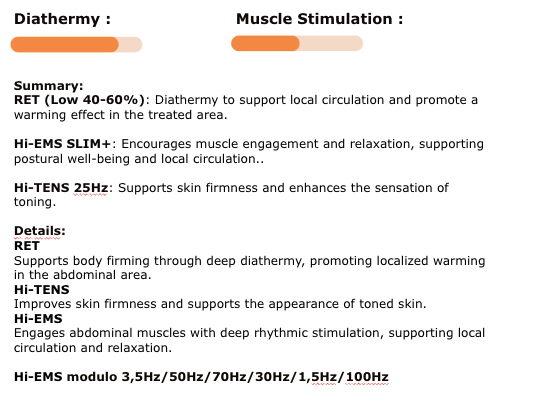
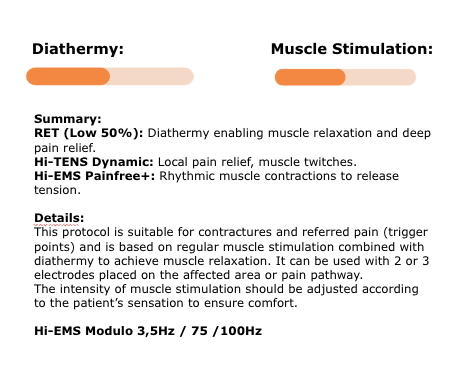
Device: Winback BACK4 (Winback, France); manufacturer-preset programs: Slim+, Pain Free+, Fit+
Key Words: TECAR; medium frequency muscle stimulation; Hi-EMS; core stability; intrinsic core; low back pain; side bridge; curl-up; McGill assessment; aesthetic rehabilitation; abdominal circumference
Summary (Abstract)
This case series describes the outcomes of simultaneous radiofrequency (TECAR) and medium frequency electrical muscle stimulation (EMS) delivered via the Winback BACK4 device in six patients presenting with low back pain and intrinsic core weakness. Patients were screened with standard orthopedic, neurological, and functional assessments. Baseline and post-treatment measures included the McGill Curl-up and Side Bridge tests (timed in seconds) and abdominal circumference at the umbilicus. No additional exercises were prescribed during the treatment period.
Each patient received 8 sessions (2 per week for 4 weeks) using one of three manufacturer-preset programs (Slim+, Pain Free+, or Fit+) with EMS intensity set to patient tolerance. At 8-session reassessment, all six patients demonstrated improvement in lateral core endurance (Side Bridge), five of six showed improvement in flexor endurance (Curl-up), and bilateral symmetry of Side Bridge performance improved across the cohort. Of five patients in whom abdominal girth was measured, all five showed a reduction ranging from 1 to 5 inches at the umbilicus.
This novel approach is promising in the treatment of both acute and chronic low back pain as strength was improved without the incorporation of additional exercises at home or in the clinic indicating a broad spectrum of low back pain patients may benefit from this protocol. An additional benefit is a reduction in the midline girth, indicating this protocol has an effect on aesthetics.
Key take-away lessons:
- The simultaneous application of TECAR and medium frequency EMS via the Winback BACK4 Slim+/Pain Free+/Fit+ protocols produced measurable improvements in intrinsic core endurance across all six patients – without any additional exercises, at home or in the clinic. This positions the protocol as a viable option for patients who cannot engage in active rehabilitation.
- Bilateral Side Bridge symmetry improved in all patients, including those with notable pre-treatment asymmetries. Restoring left-right balance in lateral core endurance is clinically important, as unilateral weakness has been associated with lumbar pain syndromes and movement dysfunction.
- Reductions in abdominal girth occurred alongside functional improvements, suggesting that the simultaneous TECAR + EMS approach acts on both neuromuscular function and soft tissue composition.
- This case series reinforces the value of passive-capable neuromodulatory tools in populations with fear-avoidance behavior, post-surgical deconditioning, or high pain sensitivity, where active exercise is a barrier rather than a starting point.
Introduction
Low back pain has been associated with loss of strength and endurance of the intrinsic core musculature as a result of disuse, micro-trauma, or macro-trauma. Beyond global strength deficits, unilateral imbalances in the frontal and sagittal planes have been specifically implicated in lumbar pain syndromes and movement dysfunction. Effective rehabilitation of the intrinsic core (including the transversus abdominis, multifidus, and lateral abdominal wall) is central to both acute and chronic low back pain management.
A clinically significant challenge in this population is patient participation in active exercise. Fear-avoidance behaviors, high pain sensitivity, and severe deconditioning frequently limit the ability to prescribe and progress therapeutic exercise in standard care pathways. The simultaneous application of TECAR radiofrequency with medium frequency EMS offers a mechanism to drive neuromuscular adaptations like strength, endurance, and symmetry, without requiring the patient to perform active exercise, potentially broadening the treatable population and accelerating early rehabilitation.
Patient Population and Screening
Six patients were included in this case series. All were adults over 21 years of age. Patients were screened using standard orthopedic, neurological, and functional assessments prior to inclusion.
Exclusion criteria:
- Nerve root compression or traction signs
- Progressive loss of lower extremity strength
- Active cancer
- Pregnancy
- Implanted electrical appliances (pacemaker, spinal cord stimulator, etc.)
Individual patient demographics and diagnoses are documented in the Results table. Patients are de-identified by age and sex. Symptom duration is not recorded in the source.
Clinical Findings – Baseline Assessments
All six patients underwent standardized functional testing at baseline and at 8-session reassessment. The following assessments were used:
- McGill Curl-up Test: timed flexor endurance (seconds).
- McGill Side Bridge Test: timed lateral core endurance, left and right independently (seconds). Bilateral values allow assessment of left-right symmetry.
- Abdominal circumference: measured at the umbilicus (inches). Recorded as a biometric marker of aesthetic outcome. Not tested (NT) for the Female 56yo Pain Free+ patient.
Individual baseline values are documented in the Results table below.
Treatment and Intervention
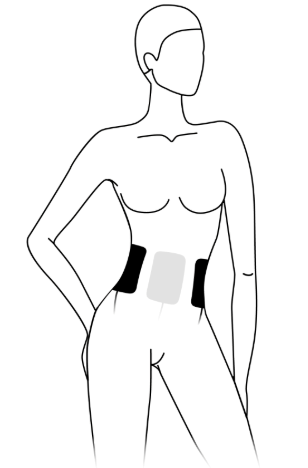
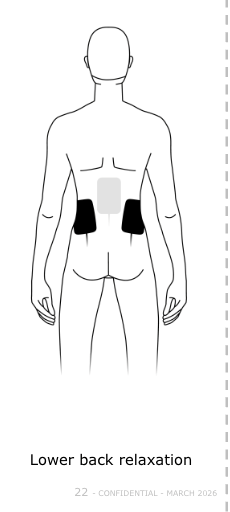
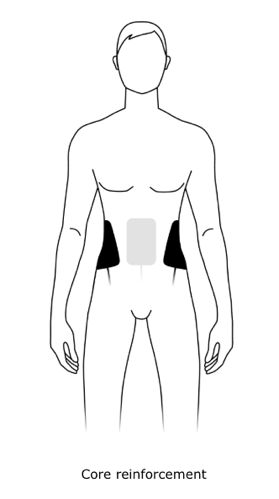
Treatment consisted of simultaneous application of TECAR and EMS using the Winback BACK4 device with CARE+ manufacturer set protocols. TECAR and EMS were delivered concurrently via adhesive contact pads: active pads placed over the bilateral obliques (lateral torso) and a return pad placed over the rectus abdominis. Patients were instructed not to change any other activities or home exercise programs during the treatment period.
| Electrode Placement | EMS Parameters | Sessions | Duration |
| Active adhesive contact pads: bilateral lateral torso (over obliques). Return adhesive contact pad: rectus abdominis. | Winback BACK4 manufacturer-preset programs: Slim+, Pain Free+, or Fit+ (program assigned per patient). Intensity: patient tolerance — strong but comfortable stimulation. | 8 sessions (2x/week × 4 weeks) | Per session duration not specified. |
Program selection rationale:
- Slim+ (3 patients, all female, ages 51–61): Selected for patients presenting with deconditioning and chronic LBP, over-deconditioning, or chronic pain that was preventing exercise participation. All three had global core weakness as the primary deficit.
- PainFree+ (2 patients, 1 male age 66, 1 female age 56): Selected for patients whose chronic LBP was the primary limiting variable in activities of daily living, where pain management was the prerequisite for any functional progress.
- Fit+ (1 patient, female age 31): Selected for a “weekend warrior” presentation – overall conditioning fair, BMI normal, but significant bilateral imbalances and exercise-provoked LBP and shoulder pain limiting training frequency. Goal was asymmetry correction and tolerance-building rather than de-deconditioning.
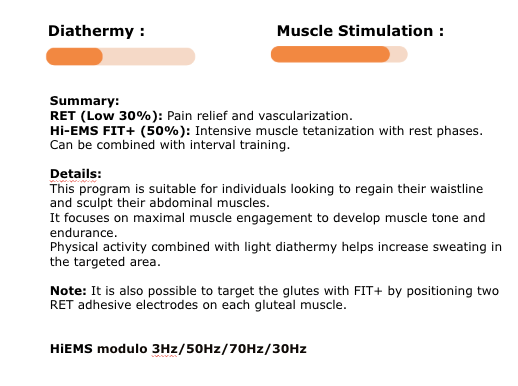
Protocols and Pad Placements
Slim+ (28:00)
PainFree+ (20:00)
Fit+ (20:00)
Adverse Events: None documented. All patients tolerated treatment well.
Results
Pre- and post-treatment assessment results for all six patients are presented below. All patients completed 8 sessions (2 per week for 4 weeks).
| Patient | Program | Curl-up Pre → Post | L Side Bridge Pre → Post | R Side Bridge Pre → Post | Girth @ Umbilicus Pre → Post |
| Female, 51yo Chronic LBP, deconditioning | Slim+ | 9 sec → 60+ sec | 29 sec → 60+ sec | 33 sec → 60+ sec | 36″ → 34″ (−2″) |
| Female, 53yo Chronic LBP, deconditioning | Slim+ | 23 sec → 28 sec | 30 sec → 60+ sec | 30 sec → 60+ sec | 44″ → 39″ (−5″) |
| Female, 61yo Chronic LBP, deconditioning | Slim+ | 20 sec → 37 sec | 30 sec → 35 sec | 26 sec → 27 sec | 42.5″ → 38″ (−4.5″) |
| Female, 56yo Deconditioning; LBP pain-limiting ADLs | Pain Free+ | 3 sec → 8 sec | 30 sec → 41 sec | 12 sec → 42 sec | NT |
| Male, 66yo LBP; DJD; lumbar stenosis | Pain Free+ | 9 sec → 9 sec | 35 sec → 60+ sec | 55 sec → 60+ sec | 44″ → 43″ (−1″) |
| Female, 31yo Deconditioning; LBP + shoulder pain post-exercise; fair conditioning, normal BMI | Fit+ | 41 sec → 60 sec | 11 sec → 42 sec | 18 sec → 42 sec | 30″ → 28″ (−2″) |
Key findings:
- Lateral core endurance (Side Bridge): improved bilaterally in all 6 patients.
- Flexor endurance (Curl-up): improved in 5 of 6 patients. Male 66yo (Pain Free+) showed no change in curl-up (9→9 sec) but achieved marked lateral core gains.
- Bilateral Side Bridge symmetry: improved in all patients. Pre-treatment L/R asymmetries were notably reduced at reassessment (e.g., Female 56yo Pain Free+: pre 30 / 12 sec → post 41 / 42 sec; Female 31yo Fit+: pre 11 / 18 sec → post 42 / 42 sec).
- Abdominal girth (5 patients measured): all 5 showed reduction, ranging from −1″ (mc) to −5″ (md).
- No additional exercises were prescribed. All improvements were achieved through the TECAR + EMS protocol alone.
Discussion
All six patients demonstrated improvement in symmetry of strength and endurance within the abdominal core musculature following 8 sessions of simultaneous TECAR and medium frequency EMS. The absence of any prescribed supplemental exercise is clinically significant: improvements occurred through a passive-capable device protocol, indicating that this approach can drive neuromuscular adaptation without relying on patient-generated effort or active participation. This has direct relevance for patients who present with fear-avoidance behavior, severe deconditioning, or pain levels that preclude exercise participation – populations in whom standard active rehabilitation is frequently delayed or ineffective in early stages.
The reduction in abdominal girth across five patients suggests that the protocol produces changes beyond pure neurological recruitment, likely including effects on soft tissue composition and fluid dynamics consistent with TECAR’s known influence on local metabolism and lymphatic flow. The convergence of functional and aesthetic outcomes positions this protocol at the intersection of clinical rehabilitation and aesthetic medicine, a rapidly growing area. As the authors note, this has potential relevance in body contouring, scar management, and age-related soft tissue change.
Notably, regardless of which manufacturer-preset program was applied, every patient achieved improved core strength and all but one achieved improved bilateral symmetry in endurance. This cross-program consistency suggests that the fundamental mechanism (simultaneous TECAR and medium frequency EMS acting on the abdominal core) is robust across different clinical presentations, with program selection serving to optimize the approach for each patient’s starting point rather than fundamentally altering the physiological effect.
Limitations and recommendations: This is a small case series without a control arm, which limits conclusions about causality. Symptom duration is not documented for individual patients. Longitudinal follow-up to determine durability of outcomes would further assist clinicians in designing appropriate maintenance protocols.
Patient Perspective
Patients in this case series completed all 8 treatment sessions over the four-week protocol period. No adverse events or complaints of discomfort were documented. As a group, patients demonstrated progressive improvement in functional testing outcomes, with the most pronounced gains occurring in lateral core endurance and bilateral symmetry.
Informed Consent
Informed consent documentation available upon request.