
How TECAR therapy works
Radiofrequency energy, directed where you need it.
TECAR completes a circuit through the treated area, so the energy travels through the tissue, not just across the skin. You choose how deep it goes and how strong it feels.
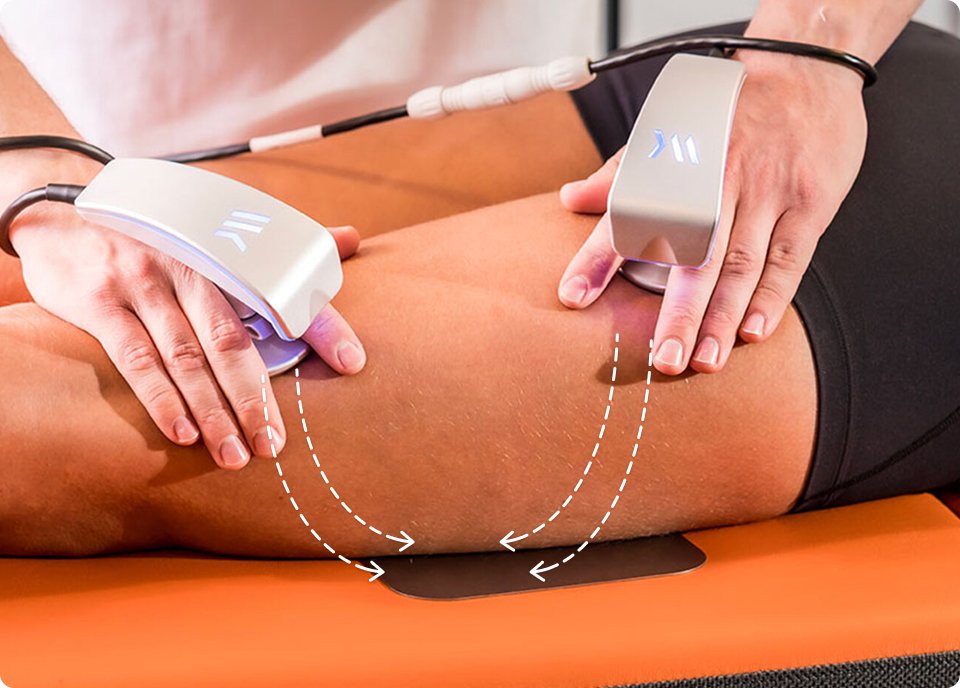
1The circuit
The treated area becomes part of a closed loop.
With TECAR, current passes through the tissue between two electrodes, so warmth is produced inside the treated area.
The unit generates RF current
2CET, RET and MIX
CET, RET and MIX heads each target different tissue.
CET and RET use the same metal electrode. The only difference is a ceramic coating on the CET head, and that coating changes where the energy goes. MIX puts both electrodes in one head and keeps the energy at the skin. Switch heads and watch where it concentrates. The bars show relative emphasis by tissue in this model.
CET works the soft tissue.
- Electrode
- Emphasis
Relative emphasis, not a hard boundary. Placement, contact, frequency, current and tissue makeup all shape the real pathway.
3Current
TECAR works with or without heat.
Winback treats in both athermic and thermal ranges, so you can support tissue healing with or without heat. At low intensity, energy moves through the tissue with little or no warmth, which suits acute presentations. Raise the intensity and warmth builds quickly, so small changes near the top of the range make a big difference.
Illustrative relationship (heat ∝ current²), not device settings or measured temperature.
4Frequency
Use frequency to shape where the energy goes.
Winback units run at 300 kHz, 500 kHz and 1 MHz. With the CET and RET heads, 300 kHz spreads the energy broader and deeper, and 500 kHz keeps it tighter to the electrode. 1 MHz is the MIX head’s frequency, and it holds the energy at the skin. The tissue itself also affects how the energy travels.
Why no return plate? The MIX head has the active and return electrodes built into the head itself. Current only travels between them, so it stays in the skin and, at most, the fascia just below. That’s why MIX is used mostly in aesthetic treatments.
Waveform is slowed billions of times so you can see it. The three waves keep their true 3 : 5 : 10 ratio.
5Try it
Combine the settings.
This is the decision a clinician makes every session: which head, how much current, which frequency. CET and RET run at 300 or 500 kHz. 1 MHz belongs to the MIX head, so picking it switches the head for you. Change any setting and the model redraws.
MIX: active and return electrodes are both in the head, so there’s no return plate and the energy stays at the skin. Mostly used in aesthetic treatments.
In the body
What happens in the body, from cells to movement
The responses happen together, connecting the physics above to what the patient feels and what you see on the table.
In a session
TECAR fits into the treatment you already give.
Patients feel adjustable warmth while you do the treatment you already planned.
During manual work
The handpiece moves with your hands through soft tissue work and mobilization.
During movement
Run TECAR while the patient goes through guided motion, activation or exercise.
Adjusted live
Mode, current and frequency change on the fly based on the goal and patient feedback.
Now see it on a patient.
Book a demo and feel the difference between capacitive and resistive on your own tissue.
Questions we hear first.
What is TECAR therapy?
TECAR is a radiofrequency treatment. Current passes between an electrode and a return plate, through the tissue you're treating. You choose the depth and the intensity, so a patient may feel gentle warmth or very little at all. It's used to support healing, relieve pain and improve mobility.
Is it hard to learn?
This is the question we hear most. Every device includes personalized onboarding, and the guided protocols on board mean a newer clinician can deliver a structured session on day one while they build hands-on technique. Live webinars and courses continue for as long as you own it.
How is it different from laser, ultrasound or shockwave?
Laser uses light, shockwave uses acoustic pressure waves and ultrasound uses sound. TECAR uses an electrical circuit: current runs between an electrode and a return plate, through the tissue you're treating. That circuit is why it can run through a handpiece, pads or bracelets. Each has its place. There's a full breakdown on the technology comparison page.
How long is a session?
Most treatments run 10 to 20 minutes. Guided protocols run 20 to 30 minutes and can be delivered hands-free while you work with another patient.
What support do I get after I buy?
Personalized onboarding, ongoing access to the training team, live webinars and courses, plus activation support such as open houses and marketing materials to launch it with your patients. That's the Winback Ecosystem.
Book a demo
Tell us about your practice and the right person on our team will reach out.
Prefer to talk? Call (914) 356-3615. Patients looking for treatment can find a clinician.