
Provider Name & Treatment Location: Juniper PT (provider details and treatment location not further specified in source documentation)
Key Words: Slim+ protocol; TECAR therapy; abdominal circumference; body composition; 3D body scanning (Styku); heart rate variability (HRV)
Summary (Abstract)
Note: this report differs from a standard single-patient case report in that it summarizes a pilot cohort of 12 participants (8 female, 4 male). It is presented here adapted to the standard case-report template.
The Slim+ protocol is designed to decrease abdominal circumference and improve body composition. Juniper PT conducted a pilot study of this protocol with 12 participants, combining objective measurements from 3D body scanning (Styku), circumferential measurements, body weight, heart rate variability (HRV), and subjective weekly reflections.
Across the cohort, circumference measurements, subjective reports, and HRV trends consistently moved in a positive direction, while estimated body fat percentage showed a surprising increase for the majority of participants despite stable body weight. This pattern strongly suggests limitations in body composition estimation by the Styku system rather than true biological fat gain, and indicates that the Slim+ protocol is associated with improvements in body shape and physiological regulation.
Key take-away lessons:
- Despite body weight remaining largely stable across participants (changes limited to ±1-6 lbs, within normal fluctuation), participants — especially female participants — demonstrated marked reductions in abdominal circumference of up to approximately 5 inches.
- The Styku 3D optical scanning system derives body composition estimates from circumferential geometry and body shape rather than direct measurement (e.g., bioimpedance), meaning changes in posture, muscle tone, core engagement, and regional body shape can skew fat-percentage estimates even when true tissue composition is improving.
- Subjective outcomes were overwhelmingly positive: 75% reported improved strength or tone, 67% reported improved or more stable energy, 50% reported improved digestion or reduced bloating, and 67% reported increased body awareness or motivation.
- Roughly 33% of participants demonstrated meaningful HRV increases, consistent with improved autonomic regulation and recovery, and these trends aligned with subjective reports of improved energy, digestion, and recovery.
Introduction
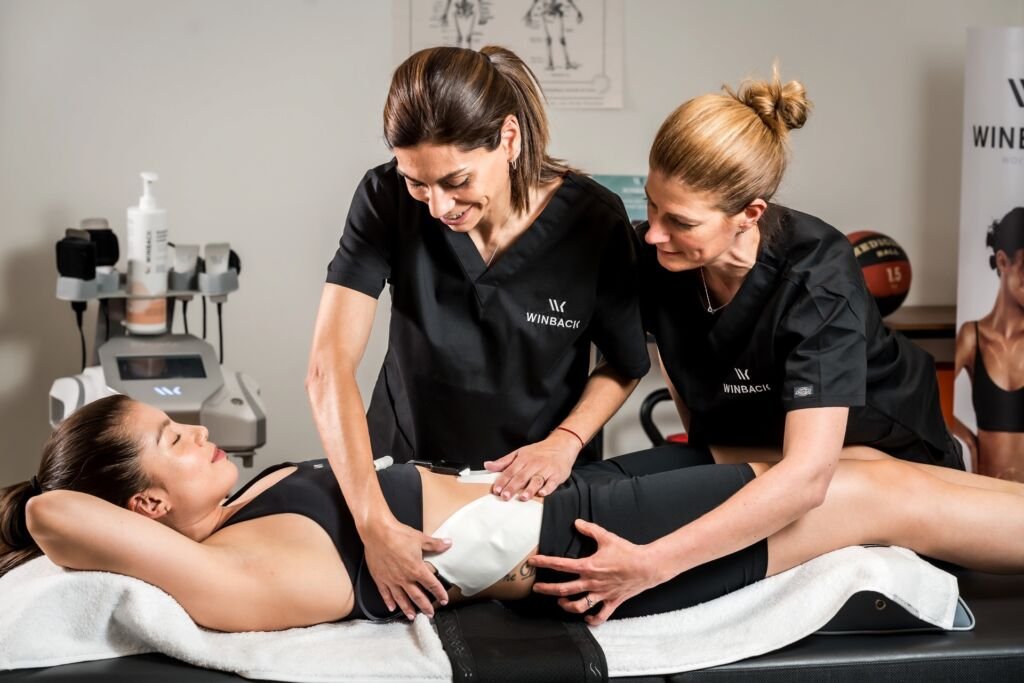
The Slim+ protocol is designed to decrease abdominal circumference and improve body composition using the Winback Slim+ mode (combined TECAR and high electrical muscle stimulation). Juniper PT conducted a pilot study of this protocol with 12 participants (8 female, 4 male), combining objective measurements from 3D body scanning (Styku), circumferential data, body weight, HRV, and subjective weekly reflections.
This pilot evaluation is reformatted here to fit the standard case-study template as closely as the cohort design allows.
Patient Information / Diagnosis
Cohort Composition: 12 participants total: 8 female, 4 male.
Intervention: Slim+ protocol (combined TECAR and high electrical muscle stimulation).
Outcome Measures Collected: 3D body scanning (Styku) for estimated body fat % and lean mass %; circumferential (abdominal) measurements; body weight; heart rate variability (HRV); subjective weekly journal reflections.
Relevant Medical/Family History: Not specified in source documentation (cohort-level summary).
Clinical Findings
Objective Body-Composition Measurement Results
The majority of participants (67%) demonstrated increases in estimated body fat percentage alongside corresponding decreases in estimated lean mass percentage, ranging from +1.2% to +8%. Only a small number of participants showed reductions in estimated body fat %. These results were surprising, as body weight remained largely stable across participants (changes limited to ±1-6 lbs, within normal fluctuation due to lifestyle, sleep, hydration, etc.). Conversely, participants — especially female participants — demonstrated marked reductions in abdominal circumference of up to approximately 5 inches. These reductions in abdominal circumference may be associated with improvements in tissue tone, reductions in bloating or inflammation, postural and neuromuscular engagement, and redistribution of local tissue.
Body-Composition Measurement Considerations
The Styku system used in this pilot does not measure body fat or lean mass via bioimpedance. Instead, Styku derives body composition estimates from 3D optical surface scans, using algorithms based on circumferential geometry and body shape — meaning estimated body fat and lean mass values are inferred rather than directly measured. Changes in posture, muscle tone, core engagement, and regional body shape can influence how these algorithms classify fat versus lean mass. With regard to the Slim+ data, the Styku scans appear to accurately capture shape change, while the translation of that shape change into fat-percentage estimates may not fully reflect true tissue composition.
Results by Sex
It is well established that males and females carry weight and distribute fat differently. In reviewing the data by sex, distinct trends emerged:
| Group | Findings |
| Male participants (n = 4) | Stable body weight, mixed changes in estimated body fat %, minimal circumference change, and HRV variability. No consistent pattern of fat gain. |
| Female participants (n = 8) | Stable body weight; 75% showed reductions in abdominal circumference (-1.7 to -5 inches); in several cases, favorable but variable HRV changes. The majority of estimated body-fat % increases occurred in this group. |
The differences in the data by sex suggest that female-specific changes in posture, tissue tone, and regional geometry may not be fully accounted for in the Styku circumference-based body composition algorithms, leading to a skewed body fat % estimate.
Subjective Measurement Results
Weekly journal responses and reflections were overwhelmingly positive: 75% reported improved strength or tone; 67% reported improved or more stable energy; 50% reported improved digestion or reduced bloating; and 67% reported increased body awareness or motivation.
HRV Results
While HRV variability across participants is expected, roughly 33% of all participants demonstrated meaningful increases, consistent with improved autonomic regulation and recovery capacity. These HRV trends aligned with subjective reports of improved energy, digestion, and recovery, suggesting HRV may serve as a complementary objective marker supporting favorable physiological adaptation during the Slim+ protocol.
Detailed Treatment, Timeline, and Outcome
1. Timeline
Participants underwent a multi-week course of the Slim+ protocol with weekly subjective journaling and periodic objective measurement (3D body scanning, circumference, body weight, and HRV); specific session counts, frequency, and total study duration were not specified in source documentation.
2. Diagnostic Assessment
Diagnostic/outcome methods: 3D optical body scanning (Styku) for body composition estimates; circumferential abdominal measurements; body weight; heart rate variability (HRV) monitoring; and subjective weekly participant reflections.
Findings: improvements in abdominal circumference, subjective strength/tone/energy/digestion/motivation, and HRV across the cohort, despite a counterintuitive increase in Styku-estimated body fat percentage for the majority of participants — attributed to limitations of circumference-based body composition estimation rather than true biological fat gain.
Therapeutic Intervention
1. Type of Intervention
The Slim+ protocol (combining TECAR-based capacitive and resistive energy transfer with high electrical muscle stimulation via the Slim+ device mode) was applied across the 12-participant cohort with the goal of decreasing abdominal circumference and improving body composition.
2. Protocol Steps
- Slim+ protocol sessions were administered to all 12 participants (8 female, 4 male).
- Objective measures (3D body scan via Styku, abdominal circumference, body weight, HRV) and subjective weekly journal reflections were collected throughout the pilot.
Specific session frequency, duration, intensity settings, and total number of sessions were not detailed in the source documentation for this cohort summary.
Treatment Protocol and Follow-Ups
Session Frequency / Techniques: Slim+ protocol (TECAR plus high electrical muscle stimulation); frequency and duration not specified in source documentation.
Clinician- and patient-assessed outcomes: 3D body scan (Styku) body composition estimates, abdominal circumference, body weight, HRV, and weekly subjective journal reflections.
Important follow-up diagnostic and other test results: See Clinical Findings above for cohort-level results by measure and by sex.
Intervention adherence and tolerability: Not specified in source documentation.
Adverse and unanticipated events: None reported.
Results after Treatment Completed
Across the dataset as a whole, circumference measurements, subjective reports, and HRV trends consistently moved in the same positive direction, while estimated body fat percentage showed a surprising increase for most participants. Estimated body-fat changes were relatively consistent across participants despite stable weight and consistent inch loss, strongly suggesting limitations in body composition estimation by the Styku system rather than true biological fat gain.
Representative participant comments included: “My back feels strong… usually it’s really sore by now”; “Stomach feels more toned”; “Energy increased slightly but more stable overall”; “Getting control over my digestion and increasing good foods”; and “It was rewarding to see the measurements positively this week.”
Discussion
Taken together, the data indicate that the Slim+ protocol is associated with improvements in body shape and physiological regulation, despite a counterintuitive increase in Styku-estimated body fat percentage for the majority of participants. This discrepancy appears attributable to inherent limitations of circumference-geometry-based body composition estimation (Styku) rather than true biological fat gain, particularly given stable body weight and consistent reductions in abdominal circumference — especially among female participants.
Limitations include the absence of a control group, the relatively small cohort size (n=12), reliance on a body composition estimation method (Styku) that may not accurately reflect true fat/lean mass changes, and variable HRV responses. Future cohorts may benefit from emphasizing circumference, weight stability, subjective outcomes, and HRV as primary indicators of success, and from considering alternative methods for more accurate estimation of fat and lean mass. Take-away: the Slim+ protocol pilot data support its association with reduced abdominal circumference (particularly in female participants), positive subjective outcomes (strength/tone, energy, digestion, body awareness/motivation), and favorable HRV trends in a subset of participants.
Patient Perspective
Weekly participant journal reflections were overwhelmingly positive, with representative comments including: “My back feels strong… usually it’s really sore by now”; “Stomach feels more toned”; “Energy increased slightly but more stable overall”; “Getting control over my digestion and increasing good foods”; and “It was rewarding to see the measurements positively this week.”
Informed Consent
Not specified in source documentation. Participant consent for use of de-identified pilot data in this report should be obtained and documentation made available on request.